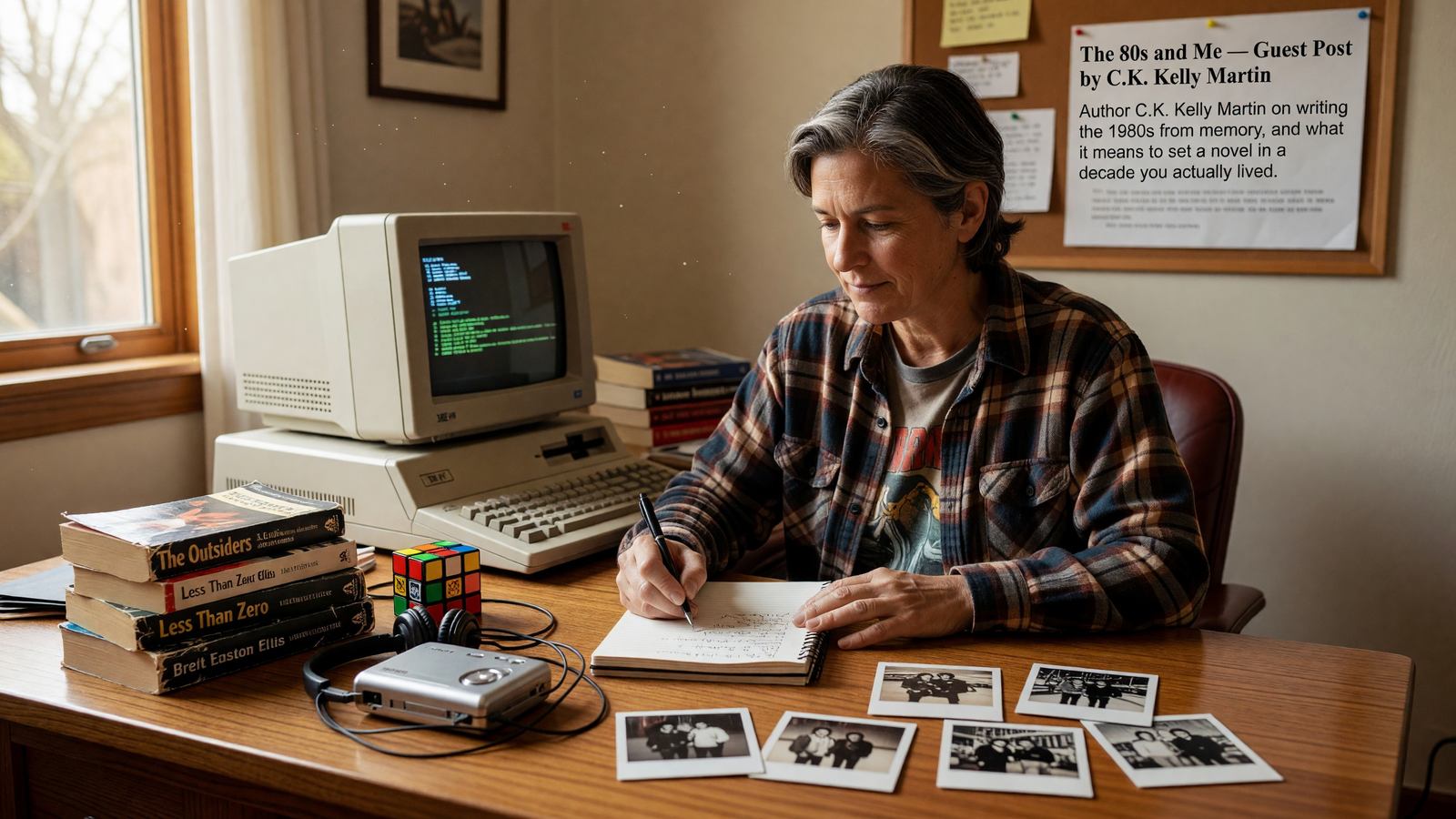
C.K. Kelly Martin is a Canadian YA author whose novel I Know It’s Over was one of the most honest books about teenage grief published in the late 2000s. Her work consistently takes the emotional lives of teenagers seriously in ways that less careful writers don’t manage. She stopped by to write about what it’s like to use the 1980s as a setting when the 1980s are your actual childhood.
Writing historical fiction set in a decade you remember is a different kind of challenge than writing about a period you’ve researched. With research, you control the gap between what you know and what you don’t. With memory, the gap is invisible — you don’t know where your recollections are wrong until someone corrects them.
When I wrote The Day I Didn’t Die (published as Yesterday in some markets), set partly in 1985, I was working from a combination of personal memory and the kind of background research you do to verify that memory. The details I was most confident about — the music, the specific social textures of being a teenager in that moment — were the ones that needed the least checking. The structural details (what was on TV, what consumer products existed, what news was in the air) required more verification.
What surprised me was how much I didn’t remember. The 1980s as a cultural category — big hair, neon, synthesizers — is so oversaturated in retrospect that separating the decade as you actually lived it from the decade as it’s been processed into nostalgia takes real effort. The 80s I remembered weren’t the 80s of the movies about the 80s.
The useful question, I found, was not “what was happening then” but “what did it feel like to be sixteen then.” The feelings are what fiction is for.
Author: C.K. Kelly Martin · Website: ckkellymartin.com
Frequently Asked Questions
Who is C.K. Kelly Martin and what is she known for? C.K. Kelly Martin is a Canadian YA author whose novel I Know It’s Over is described as ‘one of the most honest books about teenage grief published in the late 2000s.’ Her work ‘consistently takes the emotional lives of teenagers seriously in ways that less careful writers don’t manage.’ Her novel The Day I Didn’t Die (published as Yesterday in some markets) is set partly in 1985.
What is different about writing historical fiction set in a decade you remember? Martin argues that with research you ‘control the gap between what you know and what you don’t,’ but ‘with memory, the gap is invisible — you don’t know where your recollections are wrong until someone corrects them.’ The details she was most confident about — the music, the social textures of being a teenager in 1985 — needed the least checking, while structural details required more verification.
What surprised C.K. Kelly Martin about writing the 1980s from memory? ‘How much I didn’t remember.’ The 1980s as a cultural category — ‘big hair, neon, synthesizers — is so oversaturated in retrospect that separating the decade as you actually lived it from the decade as it’s been processed into nostalgia takes real effort. The 80s I remembered weren’t the 80s of the movies about the 80s.’
What question did C.K. Kelly Martin find most useful when writing the 1980s? Not ‘what was happening then’ but ‘what did it feel like to be sixteen then.’ She concludes: ‘The feelings are what fiction is for.’ This is framed as the key distinction between historical documentary and historical fiction — the interior emotional experience rather than the external facts.
Further Reading from Authoritative Sources
- historical fiction — Wikipedia’s historical fiction article contextualises the genre that Martin is discussing and working in, helping readers understand the craft challenges she describes and why writing from memory differs from conventional historical research.
- the 1980s — Wikipedia’s 1980s article provides the cultural and historical context of the decade Martin is writing about and discussing, helping readers understand the specific period texture she is trying to recover from beneath its pop-culture overlay.